Fused White Alumina Grit Size Selection for High-Temperature Refractories: Workability and Service Life
Choosing the right fused white alumina particle size distribution is a key lever for improving both installation efficiency and lining durability in high-temperature refractory systems. This article explains a practical grading strategy from ultrafine powders to coarse aggregates, showing how each fraction influences flowability, packing density, permeability, and resistance to slag/chemical attack. It also compares spherical versus irregular fused white alumina in ramming mixes, low-cement castables, and precast blocks, highlighting their different behaviors in compaction, water demand, and crack propagation under thermal shock. Customer test results from Europe and North America are referenced to illustrate measurable differences in density, flow, and spalling resistance between particle morphologies. For demanding units such as steel EAF linings and FCC reactor components, the selection logic is linked to temperature gradients and thermal-stress distribution, helping engineers match PSD and shape to real operating profiles. As a solution partner, Rongsheng Refractory Materials supports global customized grit sizing programs and provides ISO9001-certified quality control, including ultra-pure options (Al₂O₃ ≥ 99.5%) for critical applications.
Fused White Alumina Grit Size Selection: How to Improve Installation Performance and Service Life in High-Temperature Refractories
For high-duty linings, fused white alumina (WFA) is often selected for its purity, refractoriness, and stable mineralogy. Yet many failures that look “material-related” are actually particle-size related: poor flow, trapped porosity, excessive binder demand, and thermal spalling that starts from micro-defects created during installation. This guide explains a practical grading logic—from micro-fines to coarse aggregate—then compares spherical vs. irregular WFA in real refractory systems such as ramming mixes and precast shapes, using reference performance data commonly reported by EU/US users.
SEO topic: fused white alumina grit size selection
Applications: castables • ramming mixes • precast blocks
High duty: EAF • FCC • steel ladle • petrochemical
Why Particle Size Distribution (PSD) Matters More Than Many Specs
In refractory engineering, PSD is a quiet “multiplier” that affects both workability and in-service reliability. With the same chemistry (e.g., high-purity alumina), changing the ratio of coarse/medium/fine can shift bulk density, water demand, and crack sensitivity—especially under rapid thermal cycling.
Core Mechanisms (Installation → Microstructure → Service Life)
- Flowability & placement: more optimized fines can reduce segregation and improve self-leveling in low-cement castables (LCC/ULCC).
- Packing density: well-graded mixes reduce voids; fewer connected pores means better slag/alkali resistance.
- Binder demand: excessive ultra-fines increase surface area → higher water/binder → higher drying stress and crack risk.
- Thermal shock behavior: PSD impacts elastic mismatch and microcrack networks; both can help or hurt spalling depending on the thermal stress type.
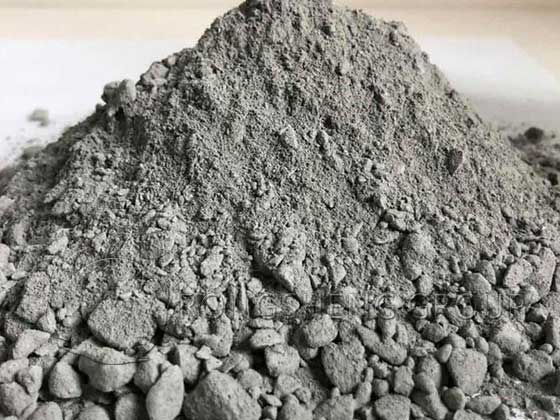
A Practical Grading Strategy: From Micro-Fines to Coarse Aggregates
A commonly used approach for high-alumina systems is a multi-modal PSD that balances “filling” (fines) with “skeleton strength” (coarse). Below is an engineering-oriented reference, widely used as a starting point for mix design. Final targets should be validated by on-site placement and thermal cycling.
| Size Band |
Typical Range |
Main Role in Refractory |
Common Risk if Overused |
| Micro-fines |
< 45 μm (including sub-10 μm) |
Improve packing, reduce permeability; assist matrix sintering |
Higher water/binder demand; drying cracks; poor de-airing |
| Fine |
45–200 μm |
“Bridges” between matrix and aggregate; stabilizes flow and cohesion |
Too much can stiffen mix and raise rebound/placement difficulty |
| Medium |
0.2–1 mm |
Load-bearing structure; controls shrinkage and cracking tendency |
If too coarse-heavy: segregation, poor surface finish, weak interfaces |
| Coarse aggregate |
1–5 mm (or up to 8 mm in some precast) |
Thermal mass, abrasion resistance, and structural rigidity |
Increased thermal stress concentration under fast heat-up/cool-down |
As a field rule-of-thumb, many ULCC/LCC designs aim for high packing with controlled ultra-fines, while ramming mixes tend to use a coarser skeleton to maintain shape under compaction and thermal cycling.
Spherical vs. Irregular White Alumina: What Changes in the Real World?
Chemistry alone does not define behavior. Particle morphology shifts friction, void geometry, and the way a lining densifies. In many Western user trials, spherical WFA is associated with easier placement and higher green density, while irregular WFA can deliver stronger mechanical interlocking in some pressed or vibrated shapes.
Application Fit (Quick Comparison)
| Refractory Type |
Preferred Morphology |
Why It Works |
Watch-outs |
| Ramming mix (EAF hot spots, troughs) |
Irregular or hybrid |
Interlocking improves stability after ramming; better “bite” under vibration/impact |
Too many sharp fines may increase binder demand and reduce flow |
| Low-cement castable (pumpable / self-flow) |
Spherical or engineered PSD |
Lower internal friction → improved flow, lower water addition, higher density |
Over-spherical can increase segregation if PSD is not balanced |
| Precast blocks / shapes (vibration + controlled curing) |
Either (case-dependent) |
Spherical improves mold filling; irregular can enhance mechanical keying in interfaces |
Choose based on joint design, thermal cycling intensity, and drying schedule |
Quoted Field Data (EU/US Customer Trials — Reference Ranges)
In ULCC lining trials at 110°C drying + 1000°C firing, users typically reported:
+1.5% to +3.5% higher bulk density and
10%–25% lower water demand when switching from predominantly irregular WFA to spherical/hybrid grading. In thermal shock cycling (ΔT 800–1000°C), spalling resistance improvements of
~15%–30% were observed when PSD was tightened and ultra-fines were controlled.
Note: Actual results vary with binder system, microsilica, dispersion, and installation method.
Match Grit Size to Thermal Stress: A More Reliable Selection Logic
In harsh units like steel EAF or FCC reactors, failures often initiate where temperature gradients and mechanical constraints create peak tensile stress. That’s why a “best” PSD does not exist—only a PSD that best matches your stress mode.
Interactive Prompt
Which thermal stress type does your furnace lining face most often?
(1) Rapid quench & frequent cycling • (2) Large steady gradient • (3) Hot-face chemical attack with mechanical vibration
Type 1: Rapid Cycling (Spalling-Dominant)
Prefer a tighter PSD with controlled ultra-fines to reduce drying stress, plus morphology that supports uniform compaction. Many plants choose spherical or hybrid WFA to raise density while keeping water addition low, then tune microcrack “tolerance” via matrix design.
Type 2: Large Gradient (Constraint-Dominant)
Use graded aggregates to build a strong skeleton, but avoid overly large coarse fractions that intensify local stress. In many linings, keeping top-size around 3–5 mm with well-supported intermediates improves stability without creating “hard points.”
Type 3: Chemical Attack + Vibration (Wear-Dominant)
Focus on low permeability and a robust aggregate network. A balanced fine fraction helps seal pathways for slag/alkali infiltration, while irregular or hybrid grains may improve mechanical interlocking in ramming zones exposed to impact and movement.

Two Typical Scenarios: Selection Tips for EAF and FCC Units
Scenario A: Electric Arc Furnace (EAF) — Hot Spots & Fast Cycling
EAF hot-face zones face repeated thermal shocks, arc radiation, and mechanical abrasion. A common improvement path is to combine medium-to-coarse skeleton with a matrix designed for low water addition. Practical targets often include:
- Top size control: avoid excessive oversize; many operations stabilize around 3–5 mm in castable/precast systems.
- Flow vs compaction: where quick installation is needed, a spherical/hybrid WFA grading can reduce water and improve de-airing.
- Spalling mitigation: keep ultra-fines disciplined; prioritize consistent PSD to reduce weak layers formed during placement.
Scenario B: FCC Reactor/Regenerator — Erosion + Alkali Penetration
FCC environments punish permeability. Here, a PSD that supports high density and closed porosity helps resist catalyst erosion and alkali infiltration. Many users tighten the mid-fine fractions (while still preventing excessive water demand) and specify stable, high-purity alumina to reduce reaction sensitivity at temperature.
How 荣盛耐火材料 Supports More Predictable Lining Performance
Engineering teams often need more than “standard grit.” They need the right particle-size recipe for their installation method, curing schedule, and thermal profile. 荣盛耐火材料 focuses on consistency and fit-for-purpose supply for refractory producers and industrial end users.
High Purity Option
Available grades up to Al2O3 ≥ 99.5% to support stable high-temperature behavior and reduce impurity-driven reactions in critical zones.
Global Custom PSD Programs
Customized particle-size distributions for castables, ramming mixes, and precast shapes—helping you hit flow, density, and permeability targets more reliably.
Quality System
Production under ISO9001 quality management with batch traceability practices aligned with refractory industry expectations.
Request a Custom Fused White Alumina PSD for Your Refractory Mix
Share your application (EAF/FCC/ladle/etc.), lining type (castable/ramming/precast), and heat-up/cool-down routine. 荣盛耐火材料 can propose a globally shippable, customized grit-size solution and provide technical datasheets for your review.
Get Fused White Alumina Grit Size Guidance & Technical Datasheet
Tip: If you can provide target bulk density, installation method, and maximum ΔT per cycle, the recommendation can be narrowed faster.